



Spammy words: how to prevent your emails from ending up in spam folders?

Reading time: 7 minutes
What are spammy words?
We are in the middle of the sales period; it's an important time for e-commerce.
To boost their sales, all brands are increasing the volume and frequency of their solicitation emails… And that's where the problem lies: the the opening rate As sales decline, complaints increase, deliverability collapses, and we regretfully note that many messages have ended up in the "junk mail" folder instead of reaching the inboxes of potential customers.
In the marketing department, it's all hands on deck: managers are contacting their agency and their email service provider, questioning their ability to deliver messages effectively during this crucial period for revenue. They're scrutinizing the provider's reputation, SenderScore, and IP addresses to see if they've gone into the red, etc., etc…
But often the answer lies directly in the nature of the messages sent. From the subject line alone, some brands condemn their emails: "SALE: -50% discount", "exceptional offer", "great deals", "lots of free gifts", "open now and win euros"...
Spam words are keywords that regularly appear in unsolicited or promotional messages. They have a high probability of being marked as spam.
But is it really forbidden to use these words, these key phrases?
Some brands have doubts: Are you sure we have to remove these words from our emails, just because everyone else is doing it??? How can we talk about "Sales" if we can't use that word in the message?
So let's be clear:
- Nothing and no one explicitly forbids the use of these words in your emails, and using them doesn't automatically lead to spam. However, it certainly increases the risk of the message being flagged as unsolicited.
- It's not because " everyone uses these words "that it is therefore a good practice."
- Finally, removing all "spam-inducing" keywords from your messages is not a guarantee of reaching the inbox. You must pay attention to the overall quality of the message.
The real right answer lies in moderation.
What is the best practice?
Experts know that deliverability is a complex issue. Many criteria come into play, and message content is only one component among many; there is also:
- the quality of the target,
- the issuer's reputation,
- the quality of the message encoding…
However, the keyword component (used in the subject line or in the content of messages) is still important and neglecting it would be a mistake.

Indeed, FAI Anti-spam programs have rules and filters that sometimes allow messages to reach the inbox, and sometimes classify them as spam. It's impossible to know precisely which criteria are used because they vary so much (each ISP and each anti-spam program has its own rules), and these rules can change over time.
For example, it is known that the volume of marketing messages increases considerably during sales or promotional periods and that it is very likely that ISPs tighten their filtering rules during these times.
The correct practice, when you design a emailingTherefore, it is important to take care of your content; because this will inevitably be taken into account in the calculation of your anti-spam score.
Choose the subject, pre-header and each of the words used in your message carefully, avoiding the use of "spammy-words" as much as possible.
Perhaps using a simple phrase like " Free shipping on orders over €150 Written in small print in the footer, this phrase will not negatively impact your message's score. However, if this single occurrence is combined with other spammy words in the message, it could be the final straw that triggers the anti-spam filter.
Which are the errors to avoid ?
- Okay, I understand that I should avoid spammy words as much as possible, but instead of using the word "Soldes" can I bypass the anti-spam filter by separating the word with spaces or hyphens (SOLDES or Soldes)?
This is obviously a very bad ideaFirst, because this idea is as old as the hills (of email) and spammers of all kinds have already overused it. It won't fool anyone, especially not anti-spam filters, which will detect a deliberate attempt to hide the actual content of the message and immediately classify your email as spam.
It might also confuse some recipients who wouldn't see the point of breaking up the words. - What if I replaced all the spammy words with images in the message content?
Be careful, again. It's a bad ideaThis circumvention technique, which consists of replacing "spammy" words with images, is known to ISPs and anti-spam systems. Some natively integrate OCR (Optical Character Recognition) software that will immediately detect the deception.
Also keep in mind that your message must remain as readable as possible for users (even for those whose email software blocks images by default).
Do you have a comprehensive list of spammy words to avoid?
No, there isn't an exhaustive list of spam words, and it would be misleading to provide one, as it would never be up-to-date. However, we can offer a few examples. The list of keywords or phrases below is categorized. They aren't strictly prohibited by ISPs, but they can easily cause your messages to end up in the promotional folder or the spam folder, especially if they are repeated in the subject line, in clickbait, or in the message body.
Here is a list of spammy words (words that can trigger spam filters) to avoid in your email campaigns, categorized as follows:
| Category | Avoid spammy words |
|---|---|
| Promotions & discounts | Free, Win, Winner, 100% Free, Special Price, Exclusive, Quick Sale, Limited Offer, Flash Sale, Discount, Cheap |
| Finance & currency | Credit, Easy Loan, Risk-Free, Guaranteed Repayment, Fast Money, Investing, Getting Rich, High Profits, Bank Account, Credit Card, Cash, Get Rich |
| Emergency & limited time | Urgent, Act now, Limited time offer, Don't miss out, Today's offer, Immediately, Last chance, Today only, Quick |
| Exaggerated promises | Make money easily, Guaranteed results, Satisfaction guaranteed, Promise, Zero risk, Magic, Miracle, Unprecedented, Instant results |
| Freebies & gifts | Gift, Claim, Free, Free gift, No cost, No fees, None commitment0%, Get it now, Bonus |
| Strong calls to action | Click here, Click now, Download now, Order today, Reserve your spot, Join now, Buy now, Confirm your participation, Register |
| Security-related expressions | Protected, Secure, 100% Guaranteed, Confidential Information, Risk-Free Guarantee, Maximum Security |
| Health & well-being | Cure, Remedy, No Side Effects, Miracle Cure, Proven Results, Lose Weight Fast, Alternative Medicine |
| False sense of urgency | Don't miss out, don't worry, it ends soon, before it's too late, exclusive offer, action required |
| Deceptive marketing techniques | Tested, Approved, Recommended, Special Offer, Limited Reviews, Better Than Expected, Earn More, Sign Up for Free |
This list is not exhaustive, but it provides an overview of the words and phrases most commonly considered "spammy" by email service providers. It is recommended that you test your emails before sending them to ensure they do not trigger spam filters.
Today, most ISPs have powerful anti-spam systems equipped with machine-learning algorithms capable of analyzing messages in real time and interpreting user behavior (opens, clicks, or message reports). These algorithms can adjust their filtering rules in real time based on current trends and previously reported threats (attacks, phishing). A common word, a proper noun, or the name of a brand or product can therefore become "spammy" overnight if associated with abuse or threats, and disappear from the list of suspicious words as soon as the threat is eliminated.
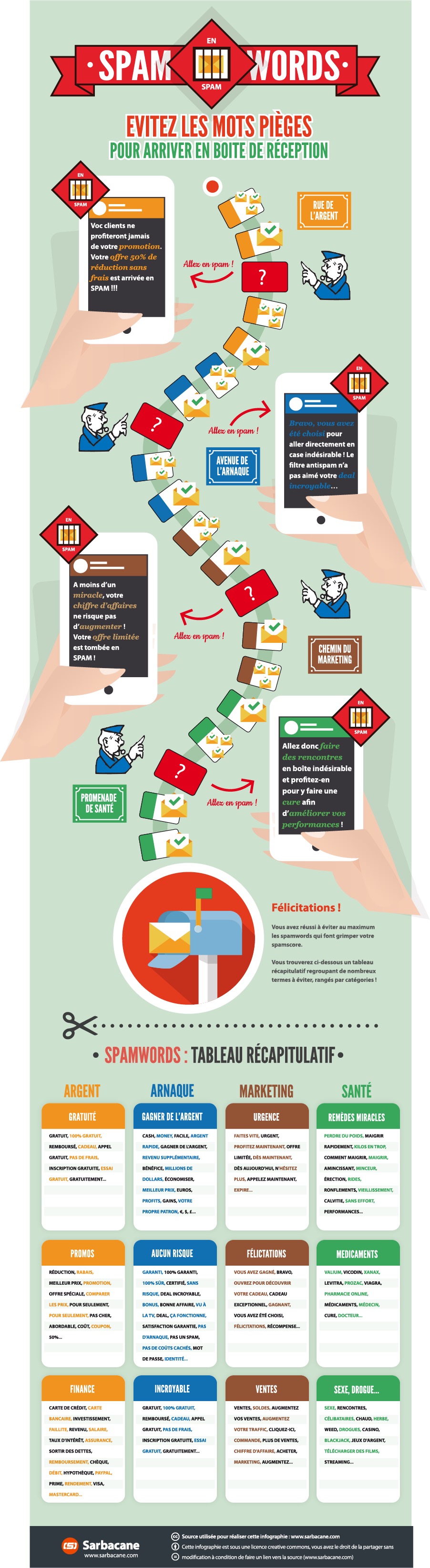
Infographic: Spammy words to avoid to reach the inbox.
In 2016, an email sending software publisher (Sarbacane) published an infographic (below) that classifies some "trap words" by category (promotional words, words evoking free services, money, certain medications, dating, sex, drugs, etc.).
Even if these words are not strictly "forbidden" by ISPs, they are obviously words that are best avoided in your messages if you want your messages to be properly delivered to the inbox.
In conclusion: test your messages before sending them…
Let's be honest, no method or solution can guarantee 100% reliability.
All automated testing tools in mode Exits They have one strength: they allow you to obtain a quick diagnosis.
But they have a huge weakness: they base their results on anti-spam software like Spam Assassin which only analyzes the content of the message to provide you with a spamscore indicator.
As we've seen, ISPs are equipped with even more sophisticated hardware systems, such as the Barracuda email gateway. Their tools are capable of:
- to check the sender's reputation in real time and ban spammers,
- to thoroughly scan the content of the message (including images and links that are tracked and analyzed)
- to learn in real time if a message is spam based on user behavior (opening, deleting, complaining…).
Testing your message with an online solution is therefore necessary , but not sufficient . At best, it will give you an idea of the risk (low, medium, or high) of ending up in the spam folder. This will protect you from a major spam classification problem, but it won't advise you on the actions to take to improve your overall deliverability.


